

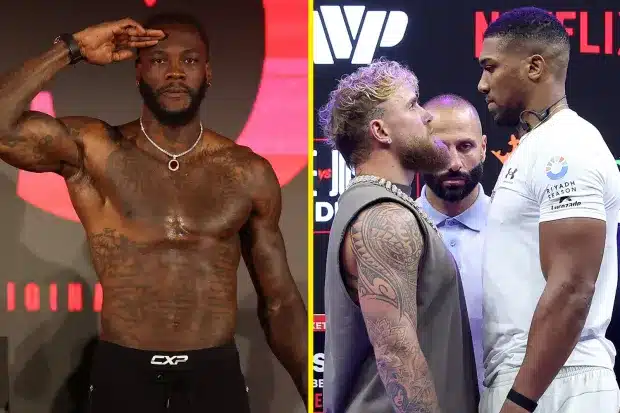
STWF Sports | Dec. 9, 2025 – In a sport built on hierarchy, pedigree, and legacy, the idea of Jake Paul sharing a ring with Anthony Joshua still feels surreal to many. Yet the bout is happening—December 19 in Miami, eight professional heavyweight rounds, streamed globally on Netflix with ten-ounce gloves and all the spotlight of a marquee prizefight.
The backlash has been fierce. Boxing purists have called it a circus, fans have dubbed it disrespectful to the sport, and analysts have questioned its implications. But one voice, perhaps surprisingly, has not joined the outrage. Deontay Wilder, Joshua’s longtime rival and former WBC heavyweight champion, understands exactly why the two are fighting—and he has defended their right to do so.
Speaking with The Action Network, Wilder broke the issue down to its simplest form: business.
“If people want to see things and they’re willing to pay the money to see it, then hey, why not? It is what it is,” Wilder said. “These are the times… the generation that we’re living in.”
Wilder’s point isn’t emotional—it’s realistic. Jake Paul isn’t an accomplished fighter, but he’s one of the sport’s most effective self-promoters.
“You got these guys [influencers] coming in and they do a hell of a job of marketing themselves,” Wilder continued. “If you can build a system where you can fight anybody and hype it up to make it where people buy it, then you got what you’re looking at.”
The “Bronze Bomber” understands why many traditional fighters are furious. He fought his way up the hard way, from poverty to Olympic bronze to heavyweight gold.
“For the average fighter that knows the ropes… they’re mad, they’re mad, they’re mad. And I understand,” Wilder admitted. “I’m one of those creations that started from the absolute bottom.”
Still, Wilder sees the entertainment value. Fans tuning in want drama, chaos, knockouts. Boxing, in the end, is a spectacle—and Paul vs Joshua is undeniably drawing eyeballs.
Why the Fight Is So Controversial
The criticism surrounding the matchup is rooted in imbalance.
Jake Paul has been boxing for less than five years. He has 13 professional fights against limited opposition. The YouTube star brings attention, but not the résumé of a serious heavyweight contender.
Joshua, on the other hand, is a two-time unified world champion, a former Olympic gold medalist, and one of the most accomplished heavyweights of his era. He has fought the best—Klitschko, Ruiz, Usyk, Whyte, Pulev, and Parker. He has carried British boxing on his back for over a decade.
Paul is expected to be badly outclassed. Joshua is expected to dominate.
But if he doesn’t?
That is where anxiety turns to fear.
Wilder spelled it out clearly: if Paul pulls off the upset, Joshua’s legacy could take a devastating hit.
“If he ends up losing, getting knocked out or something… it is gonna hurt his legacy,” Wilder warned. “People only remember the last thing you’ve done. We live in a world of ‘what have you done for me lately?’”
Wilder’s concern isn’t misplaced. Boxing careers have been derailed by less. One viral clip, one highlight reel knockout, one moment of bad judgment—those images live forever.
But Wilder also injected perspective into the conversation.
“He can recover from that, though, go on and do great things after that,” the former champion said. “It is all about him and what he does from there.”
The Verdict
Deontay Wilder is not embracing the fight. He’s acknowledging it.
He knows the risks, especially for Joshua. He knows the resentment among traditional fighters. But he also knows boxing is now part sport, part spectacle—and spectacle pays.
In the end, Wilder summed up what Paul vs Joshua truly is:
“I just look at these opportunities as fun… fun opportunities for the masses… and a money grab.”
Agree or not, that’s exactly what it has become.
The bell rings December 19 in Miami. By December 20, one man’s legacy—and perhaps boxing’s sanity—may look very different.