

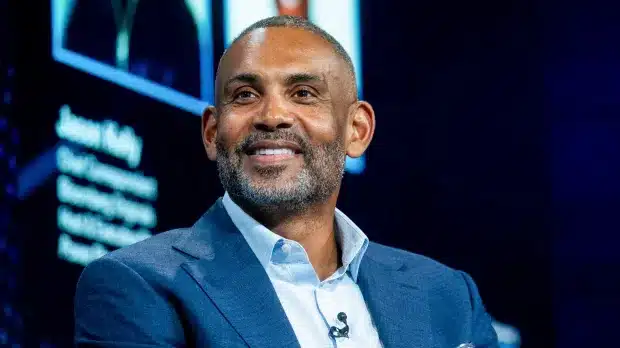
Few careers in NBA history spark more “what if?” reflections than that of Grant Hill. He is a Hall of Famer, a seven-time All-Star, a former MVP contender — and yet even those lofty accolades feel like a fraction of what he was destined to be.
Because before injuries reshaped his career, Hill looked like he was building the résumé of the next NBA megastar, the kind who sits alongside Larry Bird, Magic Johnson, Kobe Bryant, and the league’s most iconic names.
A Star Destined for Greatness
Selected third overall in the 1994 NBA Draft after winning two national championships at Duke, Hill entered the league with expectations bordering on mythic. He was billed as the next evolution of the Michael Jordan mold — a dynamic, all-purpose wing who could dribble like a point guard, rebound like a power forward, and create offense for everyone around him.
In an era defined by physicality and iso-heavy scoring, Hill was different — fluid, unselfish, and versatile.
He lived up to the hype immediately.
-
1995 Rookie of the Year (co-winner with Jason Kidd)
-
Four straight All-Star selections to start his career
-
All-NBA First Team candidate by his third season
-
Third in MVP voting (1997)
By the end of the 1990s, he looked like the face of the league’s next era — “LeBron before LeBron,” as many now say. He was a 6’8” point-forward who could do everything. The Detroit Pistons built their future around him.
The Injury That Changed Everything
But in April 2000, just days before the playoffs, Hill suffered a devastating ankle injury — the kind that derails legacies. He tried to play through the pain, and the damage worsened. Multiple surgeries followed. His prime years disappeared.
Miraculously, Hill carved out 13 more seasons after the injury. He became a defensive stopper, a veteran leader, and one of the league’s most respected voices. But the superstar career — the one on track for Mount Rushmore territory — was gone.
Still, Hill retired in 2013 after 19 seasons with a Hall of Fame résumé. And then his second act began.
A Business Empire Bigger Than His Playing Career
If Grant Hill’s playing career was defined by unrealized potential, his post-basketball life has been defined by exceeding every expectation.
According to CNBC, Hill’s net worth is approximately $250 million — and rising.
He made $141 million in NBA earnings, but his business success has been even greater. Hill built a sophisticated, diversified portfolio:
• Real estate investments, including a major stake in a $5 billion development project in Atlanta
• Co-owner of the Atlanta Hawks
• Part-owner of Orlando City SC (MLS) and the Orlando Pride (NWSL)
• Part of the ownership group that purchased the Baltimore Orioles in 2024
• Strategic partnerships with companies like Philips, launched three years ago
While many former players dabble in business, Hill has become a blueprint for post-career excellence — thoughtful, calculated, and wildly successful.
Still a Leader in Basketball Culture
Hill didn’t just walk away from the sport that defined him.
He is a prominent analyst for TNT and CBS, calling NBA and NCAA games with the same composure that once defined his playstyle. And he holds one of the most influential roles in American basketball: Managing Director of USA Basketball’s Men’s National Team.
He played a critical role in assembling the 2024 Olympic gold-medal roster, which featured LeBron James, Steph Curry, Kevin Durant, and one of the most talent-stacked teams in modern history.
A Legacy of Reinvention
Hill’s story is one of dual greatness.
He could have been one of the top 10 players ever — and his early career suggests that might not be hyperbole. But what he became may be even more impressive: a Hall of Fame player, a Hall of Fame businessman, and a visionary leader for the next generation of American basketball.
Grant Hill lost part of his basketball destiny to injury.
But he built an empire in its place.