

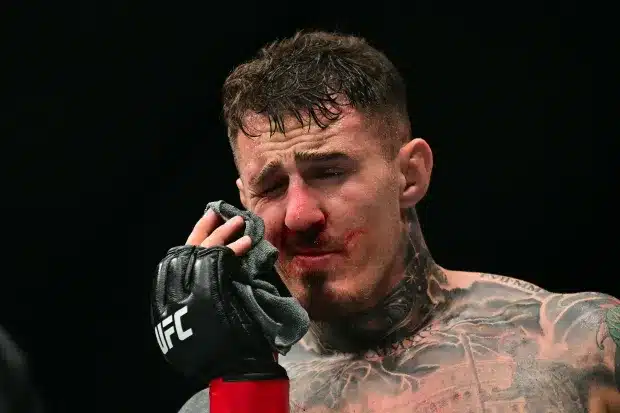
STWF Sports|(November 12, 2025) — Veteran MMA referee Herb Dean has announced that fighters will now face immediate penalties for eye pokes, marking a significant tightening of officiating standards in the wake of the Tom Aspinall vs. Ciryl Gane controversy at UFC 321.
The move comes after Aspinall suffered a severe double eye poke during his highly anticipated heavyweight clash with Gane on October 25, a fight that was ruled a no-contest after the British contender was left unable to see out of one eye. The incident has reignited debate over fighter safety and the UFC’s handling of accidental fouls.
A Fight Stopped by Disaster
The bout between Aspinall and Gane was shaping up as one of the division’s biggest showdowns of the year — until it was abruptly halted by an unintentional foul. Midway through the first round, Gane’s outstretched fingers caught Aspinall in both eyes, sending the Manchester native to the canvas in visible agony.
Referee Jason Herzog immediately paused the action and summoned cageside medical staff, but after several minutes of assessment, Aspinall was deemed unfit to continue. The 31-year-old was later transported to a hospital in Abu Dhabi for further evaluation.
Initial scans showed no permanent damage, but Aspinall was advised to return to England for additional testing before being cleared to compete again.
Herzog’s decision to rule the fight a no-contest — rather than disqualifying Gane — drew mixed reactions from fans and analysts. While some agreed the foul was accidental, others argued that intent shouldn’t outweigh impact, particularly when a fighter is left injured and unable to continue.
Herb Dean: “This Is a Dangerous Foul”
Speaking this week, Herb Dean — widely regarded as one of the most respected referees in MMA history — confirmed that the sport’s officiating body will now adopt a zero-tolerance approach toward eye pokes.
“Most of the time when we take a point, it’s a reaction to the damage or imbalance caused by a foul,” Dean explained. “But this right here is a dangerous foul, and somebody’s going to keep doing a dangerous action. We should start taking points before it actually hurts somebody.”
Under the new enforcement guidelines, any eye poke — even unintentional — will result in an immediate foul call, with referees encouraged to deduct points on the first offense if the action endangers the opponent.
If these standards had been applied during UFC 321, Gane could have faced an instant one-point deduction, potentially altering the outcome of the bout.
Divided Opinions: Jones vs. Ngannou
The fallout from UFC 321 didn’t stop at officiating debates. The incident has also sparked a war of words among some of MMA’s biggest names.
Former light heavyweight champion Jon Jones accused Aspinall of using the foul as an excuse to exit the fight early, questioning his toughness and all-around skill set.
“I feel as though Tom’s a great athlete, but I do feel like he’s a one-trick pony,” Jones said on the No Scripts Podcast. “He couldn’t touch Ciryl Gane at all. Gane was just getting warmed up — his hands were down, he was bouncing, he was comfortable.”
But heavyweight powerhouse Francis Ngannou, a former UFC champion himself, came to Aspinall’s defense, emphasizing the seriousness of eye injuries in combat sports.
“The eye poke made more headlines than the fight itself,” Ngannou told TMZ. “People don’t realize it’s not like a low blow that you can recover from. It compromises your vision — and if you can’t see in a fight, you’re risking permanent damage. Tom did the right thing by stopping.”
Ngannou also called for more respect toward fighters who choose safety over pride, arguing that the sport must prioritize long-term health over fan frustration.
A Step Toward Safer Competition
Dean’s new policy could represent a turning point for MMA officiating, where fighters’ safety is often weighed against the unpredictability of the sport.
The UFC has long struggled to find consistency in handling eye pokes, with outcomes ranging from no-contests to disqualifications, depending on the referee’s discretion.
With stricter enforcement now on the table, fighters will have added incentive to modify their defensive posture — particularly the habit of extending open hands while gauging distance.
For Aspinall, the change may come too late to salvage his title momentum, but his misfortune could lead to a safer Octagon for everyone else.
As Dean put it succinctly:
“We can’t wait for someone to lose an eye before we decide to act. This sport has evolved — our officiating needs to evolve with it.”