
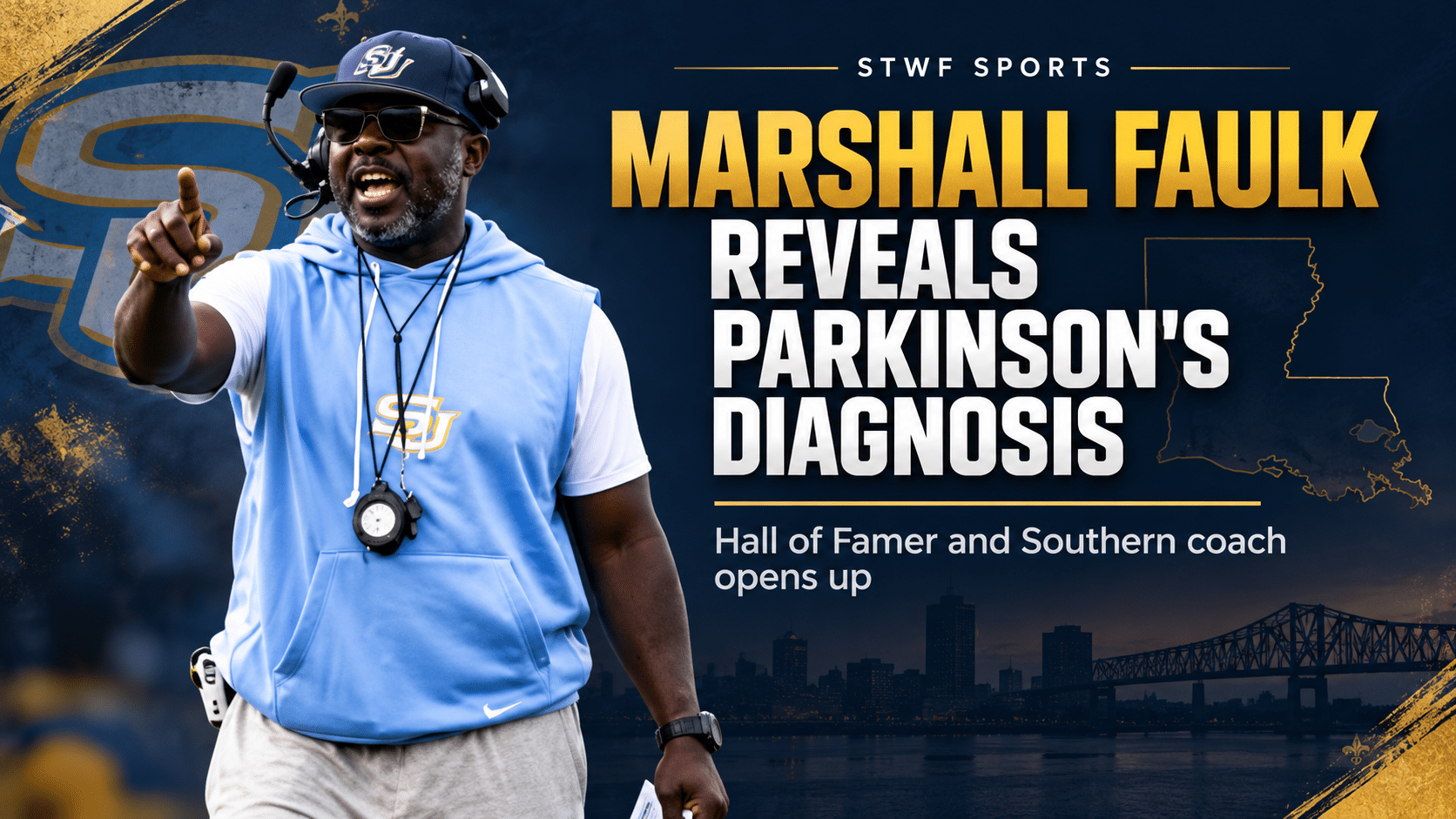
The Pro Football Hall of Famer and Southern University head coach opens up about his health while continuing a football journey that began in New Orleans.
BATON ROUGE, La. — Marshall Faulk has spent most of his life around football, from growing up in New Orleans to becoming one of the greatest running backs in NFL history. Now, the Pro Football Hall of Famer and current Southern University head coach is sharing a personal challenge that goes well beyond the football field.
Faulk, 53, revealed that he has been diagnosed with Parkinson’s disease, a progressive neurological disorder that affects movement. He discussed the diagnosis during an appearance on The Caring Neurologist podcast with Dr. Sandeep Thakkar, explaining that he has been managing the condition for approximately a year and a half.
Despite the diagnosis, Faulk says he continues to feel good and that medication has helped him manage his symptoms.
The former NFL MVP first noticed something unusual while playing golf. He began experiencing stiffness in his hands, something he initially believed was simply nerves while putting. However, when the same symptoms continued outside of competitive situations, he brought the issue to his doctor.
That conversation eventually led to further testing and his diagnosis.
Faulk said he has experienced some hand rigidity and minor tremors, but he has not noticed significant progression in his symptoms. He also shared that he has not experienced cognitive decline and continues to feel mentally sharp.
For Faulk, the diagnosis has not changed his outlook on life.
He recalled meeting boxing legend Muhammad Ali, who also lived with Parkinson’s disease, and seeing firsthand that the condition did not take away who Ali was as a person.
That experience helped shape Faulk’s perspective on his own health. Rather than viewing the diagnosis as the end of his ability to live a productive life, he sees it as something that requires attention, treatment and adjustments along the way.
Faulk also made it clear that one reason he decided to discuss the diagnosis publicly was to encourage others who might be experiencing symptoms to seek medical attention.
“I want to help as many people as I can,” Faulk said during the podcast.
Parkinson’s currently has no known cure, and its progression differs from person to person. However, treatments can help manage symptoms and maintain quality of life.
From New Orleans to the Pro Football Hall of Fame
For those in Louisiana, Marshall Faulk is more than just another former NFL star. His football story is one that began in New Orleans, long before the national recognition, professional accolades and championship celebrations.
Faulk grew up in the Ninth Ward and attended George Washington Carver High School, where he established himself as one of the area’s top football prospects.
Long before he was playing in NFL stadiums, Faulk was selling popcorn inside the Louisiana Superdome during New Orleans Saints games. It was an opportunity to be around the game he loved, even if he was watching from the stands rather than playing on the field.
His path to college football was not as straightforward as his talent might suggest. Several major programs recruited Faulk, including LSU, but wanted him to play defensive back instead of running back.
San Diego State offered him the opportunity to remain on offense, and Faulk took advantage of it.
He went on to become one of the most productive running backs in college football, earning All-American honors and establishing himself as a future NFL star.
The Indianapolis Colts selected Faulk with the second overall pick in the 1994 NFL Draft. After five seasons in Indianapolis, he joined the St. Louis Rams, where his career reached another level.
As part of the Rams’ historic “Greatest Show on Turf” offense, Faulk helped lead St. Louis to a victory in Super Bowl XXXIV following the 1999 season. He was named the NFL’s Most Valuable Player in 2000 and finished his professional career with 12,279 rushing yards, 6,875 receiving yards and 136 total touchdowns.
He was inducted into the Pro Football Hall of Fame in 2011 and the College Football Hall of Fame in 2017.
For a player who grew up watching football inside the Superdome while working in the stands, reaching the Hall of Fame was quite a journey.
A Louisiana Legacy That Goes Beyond Football
Faulk’s impact on Louisiana extends beyond his playing career.
After Hurricane Katrina devastated New Orleans in 2005, Faulk returned to his hometown and contributed to rebuilding efforts. Among those contributions was a $70,000 donation to Desire Street Ministries, an organization working with young people in the community.
It was another connection to the neighborhood where his own journey began.
His return to Louisiana football took another step when Southern University hired him as its head football coach in November 2025.
Before arriving in Baton Rouge, Faulk had worked on Deion Sanders’ coaching staff at Colorado, gaining experience at the college level. Taking over at Southern provided an opportunity to lead his own program while returning to the state where he grew up.
Southern entered this week with a 3-4 record under Faulk, and while building a winning program remains the goal, his presence carries significance beyond wins and losses.
For young athletes in Louisiana, particularly those growing up in circumstances similar to his own, Faulk represents someone who made it from a New Orleans neighborhood to the highest level of professional football.
Now he has an opportunity to pass along those experiences to another generation of players while building Southern’s football program.
His legacy in Louisiana was established long before he became the Jaguars’ head coach. His return to the state simply added another chapter.
A Different Kind of Challenge
Throughout his career, Faulk dealt with injuries, surgeries and the physical demands of playing running back in the NFL. His current diagnosis brings a different challenge, one that requires ongoing medical care rather than another rehabilitation process before returning to the field.
But Faulk has been clear about his mindset.
He continues to coach, remains active and believes that recognizing his symptoms early has helped him manage the condition.
He also pointed to actor Michael J. Fox, who has lived with Parkinson’s for decades, as another example of someone who has continued making an impact while dealing with the disease.
There is still uncertainty surrounding how the condition may progress over time, but Faulk is choosing to focus on what he can control and encouraging others to take their health seriously.
For someone whose career has been defined by his ability to make plays, the message he is sharing now is much bigger than football.
Marshall Faulk has already left his mark on the NFL, college football and his home state of Louisiana. As he continues his coaching career at Southern, he now hopes to make a difference by speaking openly about a condition that affects millions of people around the world.
And for Faulk, that may be one of the more meaningful contributions he can make.