

STWF Sports | Dec. 18, 2025 – The NFC West — long considered one of the NFL’s deepest and most dramatic divisions — delivers another instant classic Thursday night as the Los Angeles Rams and Seattle Seahawks collide in a winner-takes-all battle that will shape the postseason landscape. Both teams enter at 11-3, both believe they’re built for a Super Bowl run, and both know this primetime showdown will likely determine who claims the division crown — and who takes the tougher playoff road.
The stakes are massive: the Rams currently hold the No. 2 seed and the conference’s final first-round bye, while the Seahawks sit at No. 5 despite sharing the same record. That’s the cost — or advantage — of the NFL’s divisional tie-breaker system, a setup the Detroit Lions unsuccessfully attempted to amend this past offseason. A Seattle victory would flip the standings, giving Pete Carroll’s squad the inside track to the division title and a far more favorable postseason path.
But Thursday night isn’t just about playoff positioning. It’s a rivalry fueled by history, geography, and a dramatic near-relocation that once threatened to alter the league’s map forever.
A Rivalry Rooted in Realignment and “What Ifs”
The Rams–Seahawks rivalry officially ignited in 2002 when the NFL reorganized into a 32-team league and placed Seattle in the NFC West. Before that point, the teams rarely crossed paths. But the seeds of their eventual animosity were planted even earlier — in the mid-1990s, when both franchises were struggling with crumbling stadiums and dwindling crowds.
In 1996, Seahawks owner Ken Behring made a stunning move: he shipped team equipment to Anaheim and held offseason workouts in Southern California, openly plotting a relocation to the Los Angeles area. Behring even promised a full rebrand.
“I’m a Californian, and this is where I want to be,” he proclaimed. “We’re going to come down there with all the advantages of an expansion team… leaving all logos, pictures, trophies behind and starting out as Los Angeles’ team.”
His plan collapsed within days when NFL Commissioner Paul Tagliabue threatened fines of $500,000 per day. Behring retreated, eventually selling the franchise to Microsoft co-founder Paul Allen — a decision that not only kept the Seahawks in Seattle but ultimately built the foundation for the greatest era in team history.
Paul Allen’s Vision Transformed Seattle Football
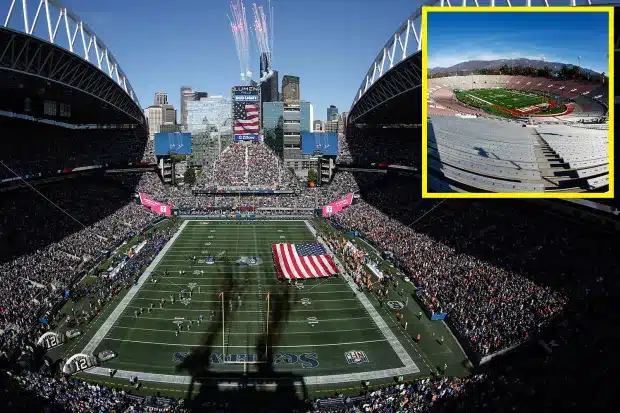
The sale of the team was contingent on local voters approving a new stadium, which they did in 1997. By 2002, the Seahawks moved into the facility now known as Lumen Field — a cathedral of noise and the future home of the “12s.”
“Paul was really the only alternative,” longtime Seahawks broadcaster Steve Raible said after Allen’s death in 2018. “He believed it was good for the community. He believed it was something that should be done to keep the team here.”
Lumen Field became the launchpad for Seattle’s golden era — including the 2014 Super Bowl triumph, the legendary Beast Quake, and the revival of football in a city that nearly lost its team.
Even Pete Carroll, now the dean of NFC West coaches, has credited Allen for his NFL return.
“I would have never left USC if not for Paul,” Carroll admitted. “Being around someone with that kind of vision… it was extraordinary.”
Los Angeles Reenters the NFL Stage
While Seattle found stability up north, Los Angeles rebuilt its football identity when the Rams moved back in 2015, followed by the Chargers in 2017. The opening of SoFi Stadium — a staggering $5.5 billion masterpiece — instantly made Southern California the epicenter of modern NFL architecture.
It’s also the venue where Seahawks receiver Cooper Kupp tasted Super Bowl glory with the Rams in 2022. Now he returns to Lumen Field, facing former teammates, familiar turf, and a rejuvenated Rams team led by a resurgent Sam Darnold — a California native rewriting his NFL story.
A Game Worth the Division
Thursday night’s matchup carries the weight of history and the promise of January football. The Rams and Seahawks have traded blows for two decades, but rarely with stakes this even, this urgent, and this closely tied to postseason destiny.
Two teams, two identical records, one playoff-shaping result.
Winner takes the NFC West.
Loser faces the long road.
Thursday Night Football just doesn’t get bigger than this.