
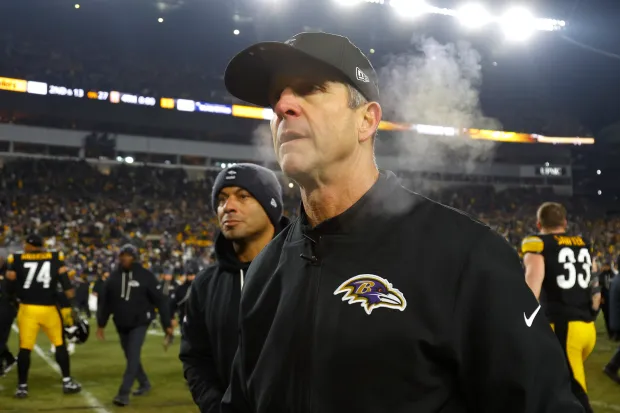
STWF Sports | BALTIMORE | Jan. 6, 2025 — One of the most stable and successful coaching tenures in modern NFL history has come to an end. After 18 seasons on the sidelines, the Baltimore Ravens have fired head coach John Harbaugh, closing a chapter defined by consistency, credibility, and a championship standard that reshaped the franchise.
Harbaugh departs Baltimore as the winningest coach in team history, compiling a 180–113 regular-season record and a 13–11 mark in the postseason. His résumé is anchored by a Super Bowl XLVII victory over the San Francisco 49ers in 2013 — a game that pitted him against his brother, Jim Harbaugh, in one of the most iconic moments the league has ever staged.
He also leaves behind an NFL record that underscores his reputation for toughness away from home: eight postseason road victories, more than any coach in league history.
Yet, in the NFL, past success rarely guarantees future security.
Baltimore’s decision follows a frustrating 8–9 campaign that saw the Ravens miss the playoffs and struggle to find consistency on both sides of the ball. While Lamar Jackson — a two-time MVP — missed several games due to injury, the season’s shortcomings went beyond availability. Defensive performance fluctuated wildly, special teams regressed, and several of Harbaugh’s late-game decisions came under intense scrutiny as losses mounted.
For a franchise built on discipline and identity, the stagnation became impossible to ignore.
Despite fielding one of the league’s most dynamic quarterbacks, Harbaugh was unable to return the Ravens to the Super Bowl during Jackson’s prime years. Over time, the sense grew that Baltimore’s championship window required not just roster tweaks, but a philosophical reset at the top.
That belief ultimately guided owner Steve Bisciotti and general manager Eric DeCosta toward a difficult decision — one that reflects a clear organizational stance. While speculation has swirled about Jackson’s long-term future, the move signals that the Ravens are committed to their quarterback and determined to find a new head coach capable of maximizing his prime.
The announcement sent shockwaves through the NFL community.
“Don’t understand this,” CBS Sports reporter Tracy Wolfson wrote on social media. “Makes you wonder what was happening behind the scenes. Harbaugh will jump to the top of a lot of teams’ lists — even those not with openings right now.”
ESPN analyst Dan Orlovsky echoed the disbelief with a single word: “HOLY.”
And then came the broader league implications. ESPN’s Adam Schefter quickly reframed the moment not as an ending, but as the beginning of a new coaching arms race.
“Multiple teams with head coach openings now will readjust their boards and are expected to pursue the newest head coaching free agent, John Harbaugh,” Schefter posted. “His availability changes everything.”
It is hard to argue otherwise.
In a league starved for proven leadership, Harbaugh’s track record makes him instantly the most accomplished coach on the market. His ability to adapt — from Joe Flacco to Lamar Jackson, from defensive-led teams to modern offensive systems — has long been one of his defining strengths. Even in a season that ended short of expectations, his reputation as a program builder remains intact.
For Baltimore, however, the calculus is about tomorrow, not yesterday.
The Ravens now enter a pivotal offseason with one of the most attractive openings in football: a stable front office, a franchise quarterback, and a roster that remains competitive with the right guidance. The next hire will shape not only the direction of the team, but the legacy of a decision that breaks from nearly two decades of continuity.
As for Harbaugh, his time in Baltimore may be over, but his career is far from finished. If anything, this moment elevates him to the center of the NFL’s coaching carousel — a proven winner suddenly available in a league where proven winners are rarely on the market.
The coaching cycle didn’t just get more interesting.
It just got rewritten.