
Skip Bertman Leaves Behind a Legacy That Forever Changed LSU Baseball
Understanding the Legacy of Skip Bertman
There was LSU baseball before Skip Bertman.
And then there is everything that came after him.
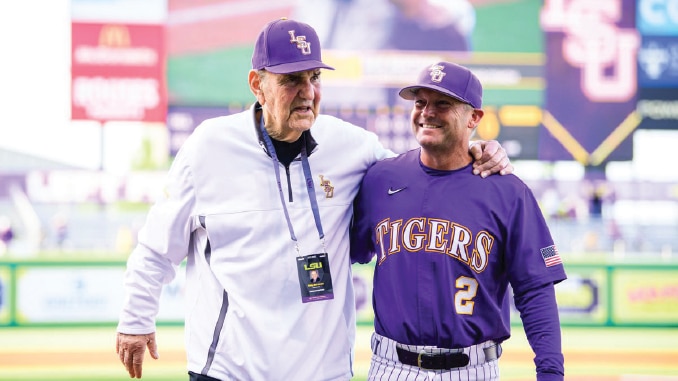
Legendary LSU baseball coach and former athletic director Skip Bertman passed away early Friday morning in Baton Rouge at the age of 88, leaving behind a legacy that reaches far beyond the five national championship trophies he brought home to LSU.
For LSU baseball, Bertman wasn’t simply one of the greatest coaches to ever do it.
He was the man who built the program into what it is today.
And for me, that legacy is personal.
It was 1992 when my dad brought me to an LSU baseball game for the first time.
The rest is history.
I was hooked.
From that point on, if LSU was playing at home on the weekend, we were usually there. Those weekends at the old Alex Box Stadium became part of growing up for me. It wasn’t just watching baseball. It was the atmosphere, the crowd, the players and watching a program that felt like it was getting bigger every year.
At that age, I didn’t understand everything Skip Bertman was building.
I just knew I wanted to be there.
And we got to witness some unbelievable moments.
One of those came in 1996 when LSU faced Georgia Tech in the championship game of the NCAA South II Regional.
Georgia Tech had cut LSU’s lead to 10-7 after scoring six runs in the sixth inning. Then came the bottom of the seventh.
What happened next was ridiculous.
LSU scored 18 runs in one inning.
The Tigers sent 22 batters to the plate and collected 13 hits in the seventh as they turned a three-run game into a 28-7 LSU lead. The Tigers eventually won 29-13 to advance to another College World Series.
Sitting in Alex Box Stadium and watching something like that happen was part of what made those years so special.
And, of course, that 1996 season would end with one of the most iconic moments in college baseball history when Warren Morris hit his two-out, two-run walk-off home run against Miami to give LSU another national championship.
Those are the moments I think about when I think about Skip Bertman.
Because his legacy isn’t just five national championships.
It’s the memories he created for an entire generation of LSU fans.
When Bertman took over LSU baseball in 1984, the Tigers weren’t the national powerhouse college baseball fans know today. LSU had experienced only limited success nationally and baseball didn’t have anything close to the following it eventually developed.
Bertman changed all of it.
Over 18 seasons, Bertman finished with an 870-330-3 record, led LSU to 11 College World Series appearances, 16 NCAA Tournament appearances, won seven SEC championships and captured five national championships.
Those titles came in 1991, 1993, 1996, 1997 and 2000.
Five national championships in ten years.
But Bertman’s biggest contribution to LSU baseball may have been something that doesn’t show up anywhere in the record book.
He changed the expectation.
Before Bertman, getting LSU to Omaha would have been considered an incredible accomplishment.
Bertman made Omaha the expectation.
He turned Alex Box Stadium into one of the toughest environments in college baseball. He helped turn LSU baseball into an event in South Louisiana. Generations of kids grew up wanting to wear purple and gold because of what Bertman and his teams built.
I was one of the kids who fell in love with it.
And that expectation never left.
Paul Mainieri added another national championship in 2009. Jay Johnson added championships in 2023 and 2025.
Different coaches. Different players. A different Alex Box Stadium.
The standard remained the same.
LSU expects to compete for national championships.
That started with Skip.
His influence also stretched well beyond the baseball diamond.
After retiring from coaching following the 2001 season, Bertman became LSU’s athletic director and served in that role until 2008. His impact on LSU Athletics continued long after he stopped filling out lineup cards.
Still, baseball will always be where Bertman’s name carries the most weight.
His No. 15 is retired. The field at Alex Box Stadium bears his name. His name is everywhere around LSU baseball.
But Bertman’s greatest monument isn’t his name on a field or a number hanging on the wall.
It’s what happens every spring in Baton Rouge.
It’s a packed Alex Box Stadium.
It’s LSU fans expecting to be playing baseball in June.
It’s kids growing up dreaming about wearing LSU across their chest.
It’s expecting to win the SEC.
It’s expecting to reach Omaha.
It’s expecting to win the whole thing.
And for me, it’s a dad bringing his son to an LSU baseball game in 1992 and having no idea that he was starting something that would stick with that kid for the rest of his life.
That’s the part of Skip Bertman’s legacy that statistics can’t measure.
There are thousands of LSU fans with their own version of that story.
Maybe it was their dad who brought them to The Box. Maybe it was their grandfather. Maybe it was watching Warren Morris in 1996 or Eddy Furniss and those late-90s teams. Maybe it was simply sitting in the bleachers on a Saturday afternoon watching LSU baseball.
Skip built something people wanted to be part of.
College baseball lost one of its giants Friday, and LSU lost the man responsible for turning its baseball program into one of the most recognizable brands in the sport.
The championships will always be part of his story.
Five national titles. Eleven trips to Omaha. Seven SEC championships. 870 victories.
But numbers only tell part of it.
For people like me, Skip Bertman’s legacy is also measured in weekends at The Box with Dad.
It’s remembering that 18-run inning against Georgia Tech.
It’s Warren Morris a few weeks later.
It’s the sound of the old Alex Box Stadium when LSU was making another run.
It’s memories that, decades later, still feel like yesterday.
Skip Bertman made LSU baseball matter.
Then he made it a powerhouse.
And somewhere along the way, he made an entire generation of kids fall in love with LSU baseball.
I was lucky enough to be one of them.
There was LSU baseball before Skip Bertman.
Everything LSU baseball has become since is part of his legacy.