
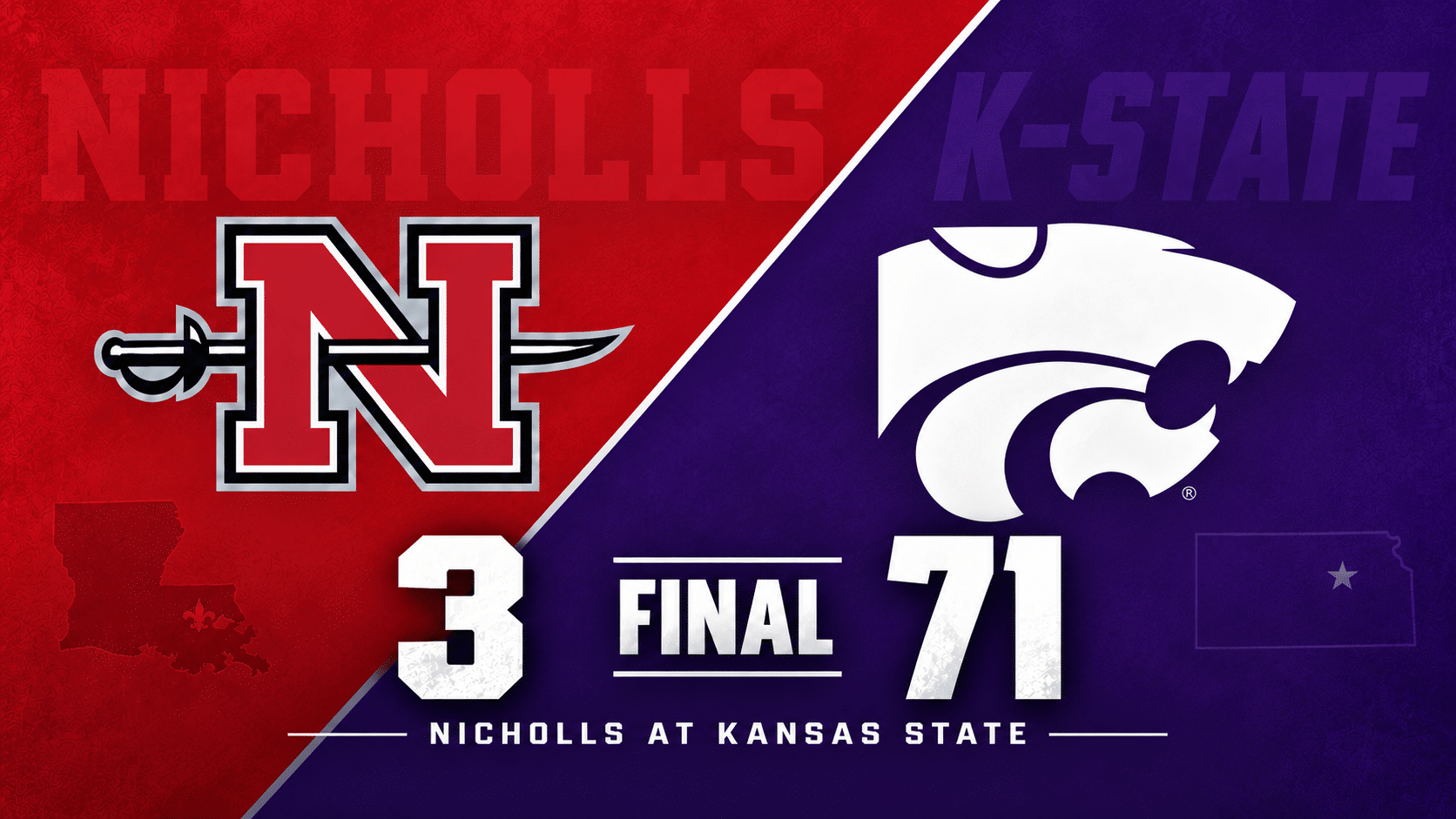
MANHATTAN, Kan. — Nicholls entered Saturday night knowing the challenge in front of it would be significant. Kansas State made sure there was never much doubt about just how large that challenge would become.
The Wildcats dominated nearly every phase of the game, piling up 559 total yards while holding the Colonels to just 122 in a 71-3 victory. Kansas State controlled the line of scrimmage, created explosive plays on offense and special teams, and never allowed Nicholls to find any sustained rhythm offensively.
For the Colonels, it was one of those nights where very little went right.
Kansas State Controls the Game From Start to Finish
The biggest difference came on the ground.
Kansas State rushed for 312 yards on 44 carries, averaging 7.1 yards per attempt and scoring six rushing touchdowns. Nicholls, meanwhile, finished with 92 rushing yards on 39 attempts, an average of just 2.4 yards per carry.
Rodney Fields Jr. led the Wildcats with 101 yards and a touchdown on 14 carries, while Monterrio Elston Jr. added 76 yards and a score on only six attempts. Jay Harris rushed for 53 yards, and Kansas State got rushing touchdowns from six different players.
Quarterback Avery Johnson was efficient through the air as well, completing 15 of 21 passes for 199 yards and three touchdowns. Kansas State quarterbacks combined to go 20-of-27 for 247 yards with three touchdowns and no interceptions.
The Wildcats finished with 34 first downs compared to only nine for Nicholls and converted nine of their 11 third-down opportunities.
That ability to stay on the field became a major problem for a Colonels defense that spent much of the night trying to contain Kansas State’s speed and depth.
Colonels Never Find Offensive Rhythm
Nicholls simply could not generate much in the passing game.
Quarterback Ean Rodrigue completed seven of 19 passes for only 30 yards, with no touchdowns or interceptions. The Colonels averaged just 1.6 yards per pass attempt and finished with only 30 total passing yards.
The ground game had a few productive moments, but never consistently moved the football.
Tamaj Hoffman led Nicholls with 43 yards on nine carries, averaging 4.8 yards per attempt. Rodrigue added 24 rushing yards, while Preston Welch finished with 17.
Jordan Smith led the Colonels in receiving with two catches for 14 yards, followed by Ellis Stewart with two receptions for 13 yards.
Nicholls’ longest completion of the night went for just 12 yards.
The Colonels’ only points came from kicker Kingston Phan, who connected on a 32-yard field goal.
Explosive Plays Add to the Damage
Kansas State did not just beat Nicholls with long, methodical drives. The Wildcats consistently created explosive opportunities.
Joe Jackson caught two passes for 48 yards, including a 43-yard touchdown reception. Garrett Oakley added 40 receiving yards on two catches, while Jaron Tibbs caught four passes for 39 yards and a touchdown.
Josh Manning also found the end zone through the air.
Special teams made matters worse for the Colonels.
Brandon White returned two punts for 69 yards, including a 65-yard touchdown return, while Sterling Lockett added a 21-yard punt return.
Kansas State averaged 30 yards per punt return, helping the Wildcats consistently flip field position and put even more pressure on the Nicholls defense.
Defense Asked to Do Too Much
Nicholls finished with 58 total tackles, led by Skylar Husband and Kennon Loftin with seven each. Gavin Duplechin added six tackles, while Zavian Dilworth finished with five.
Jhamal Shelby Jr. recorded four tackles and two pass breakups, while Alex Villavaso had the Colonels’ lone tackle for loss.
Nicholls did not record a sack or force an interception.
Kansas State, meanwhile, consistently won at the point of attack and spread the production throughout its roster.
The Wildcats finished with 49 tackles, 10 tackles for loss and a sack defensively. That pressure played a major role in preventing Nicholls from establishing anything offensively.
A Night Nicholls Has to Put Behind It
There is not much value in trying to dress up a 71-3 loss.
Kansas State was bigger, faster, and deeper, and the final numbers reflected it.
The Wildcats outgained Nicholls 559-122, held a 34-9 advantage in first downs, rushed for 312 yards, and averaged 7.1 yards per carry. Nicholls finished with only 30 passing yards and punted 10 times.
But for the Colonels, the bigger question is what happens next.
Games against FBS opponents can expose weaknesses quickly, and Kansas State did exactly that. The offensive line struggled to create consistent space, the passing game never developed, and the defense eventually wore down against an offense capable of attacking from nearly every position.
The challenge now is making sure one difficult night does not become something that carries into the remainder of the season.
What’s Next for Nicholls
Nicholls will return home looking to put the Kansas State loss behind them and get back on track.
The Colonels’ next matchup is against UT Rio Grande Valley, a game that should provide a much better measuring stick after the trip to Manhattan.
The biggest focus will be getting the offense settled back in, finding more consistency in the passing game, and reestablishing the physical identity Nicholls will need moving forward. After being held to just 122 total yards against Kansas State, sustaining drives and keeping the defense off the field will be especially important.
For Nicholls, the message now is simple: learn from it, flush it, and move on.
One ugly loss does not define an entire season. How the Colonels respond in their next opportunity will say much more about where this team is headed.