
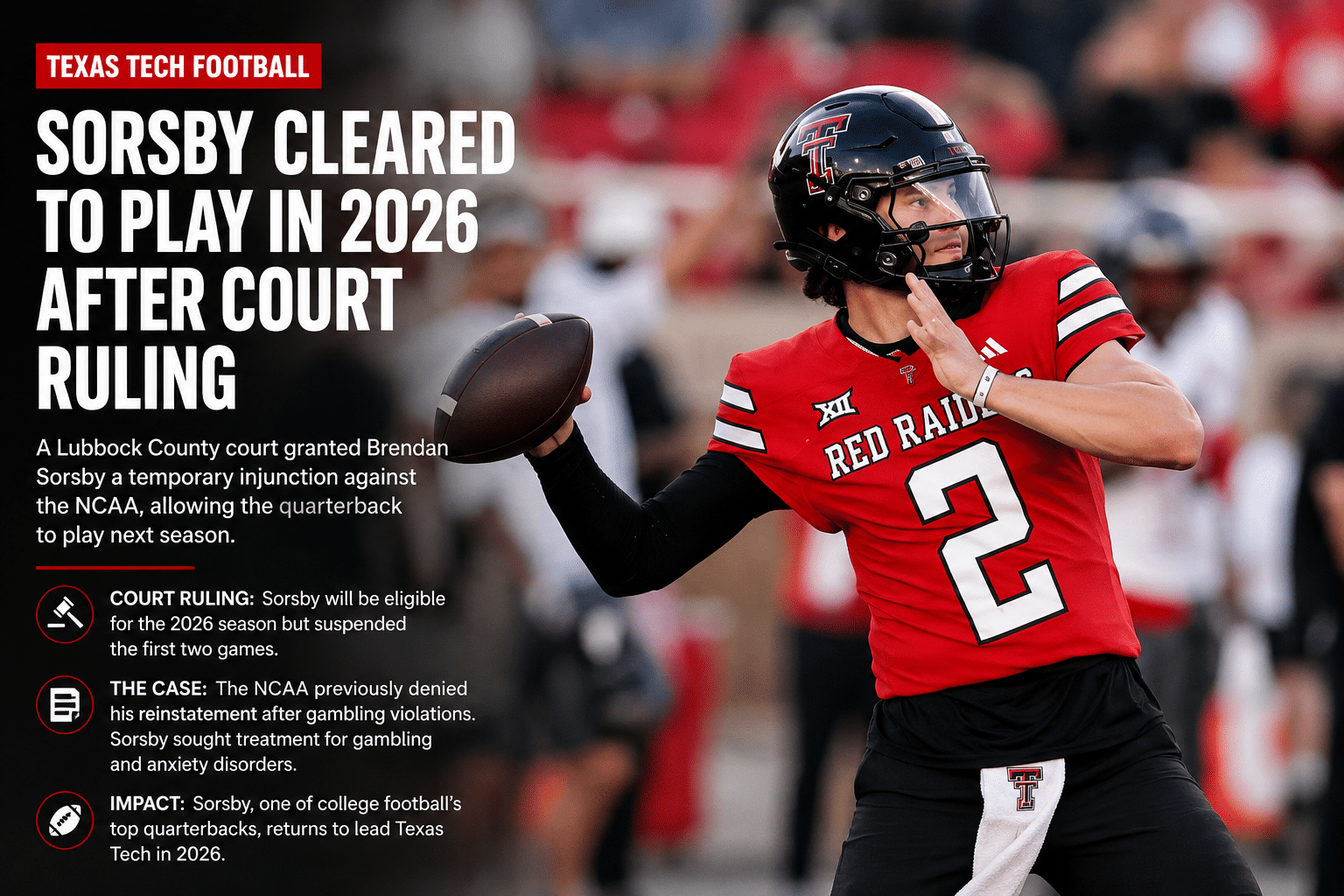
STWF Sports | LUBBOCK, Texas | June 8, 2026 — Texas Tech quarterback Brendan Sorsby received a major legal victory Monday when a Lubbock County court granted a temporary injunction against the NCAA, allowing him to participate in the 2026 college football season.
The ruling clears the way for Sorsby to remain with Texas Tech’s football team, though he will be suspended for the first two games of the season under the terms of the injunction. The decision comes after the NCAA previously rejected Sorsby’s request for reinstatement, placing the quarterback’s immediate playing future in doubt.
According to the injunction, the court found that Sorsby would face serious harm if he was not allowed to continue with the Red Raiders.
“This court finds that applicant has demonstrated that he will suffer a probable, imminent, and irreparable injury if this court does not issue this temporary injunction because he will be unable to participate as a member of Texas Tech University’s 2026 football team,” the injunction states.
The ruling is significant not only for Sorsby but also for Texas Tech, which enters the 2026 season with one of college football’s most talked-about quarterbacks. Sorsby passed on the NFL Draft this spring to return to school, and sources have told On3 that his agreement with Texas Tech is worth more than $5 million.
That decision placed even more attention on his eligibility status. Sorsby is viewed as one of the top quarterbacks in the sport entering the season, and his return was expected to be a major part of Texas Tech’s hopes in 2026.
Brendan Sorsby: Texas Tech’s Star Quarterback
The case centers on gambling violations and Sorsby’s efforts to seek treatment. According to court documents, Sorsby placed at least 40 bets involving Indiana while he was a quarterback for the Hoosiers. The documents also state he used sportsbook accounts registered to family members and friends to wager roughly $90,000 over a four-year period.
The gambling reportedly continued after Sorsby transferred from Cincinnati to Texas Tech in December 2025.
Sorsby’s attorneys have said the quarterback has been diagnosed with gambling and anxiety disorders. He checked into a gambling addiction rehabilitation center in mid-April and recently completed a 35-day stay at a treatment facility in Arizona.
That medical and rehabilitative component became a central issue in Texas Tech’s appeal to the NCAA. In its reinstatement request, the university recommended a two-game suspension rather than a maximum penalty. Texas Tech argued that a harsher punishment could send the wrong message to future athletes dealing with similar issues.
The school stated in its appeal that if the NCAA pursued the maximum penalty, “future athletes will be disincentivized from seeking the help they desperately need.”
The NCAA denied Sorsby’s reinstatement request last week, setting up the legal challenge that led to Monday’s ruling.
For now, the injunction gives Sorsby a path back to the field, though not immediately. He will miss the first two games of the 2026 season before becoming eligible to return. That outcome mirrors the discipline Texas Tech had proposed during the NCAA appeal process.
The situation is likely to spark broader discussion across college athletics. Sports gambling has become a growing concern as legalized betting has expanded across the country. College athletes are under increased scrutiny, and the NCAA has continued to enforce strict rules around wagering, particularly when bets involve an athlete’s own school or team.
At the same time, Sorsby’s case raises questions about how governing bodies should handle gambling addiction and mental health treatment. The court’s decision does not erase the gambling violations, but it does allow Sorsby to continue his college career after seeking professional help.
For Texas Tech, the ruling brings clarity to a key roster question. The Red Raiders will still have to navigate the first two games without Sorsby, but they now know their projected starting quarterback can return later in the season.
For Sorsby, the injunction represents another step in a complicated path back to competition. His legal team, the university and the court framed the issue around both accountability and rehabilitation.
The NCAA may still continue to challenge the matter, but Monday’s ruling changes the immediate outlook.
Barring another legal development, one of the most talented quarterbacks in college football will be back on the field in 2026 — just not for the first two games