
THIBODAUX, La. — Stephen F. Austin entered Saturday’s matchup against Nicholls as one of the top teams in the Southland Conference and made another strong argument for being considered the best team in the FCS.
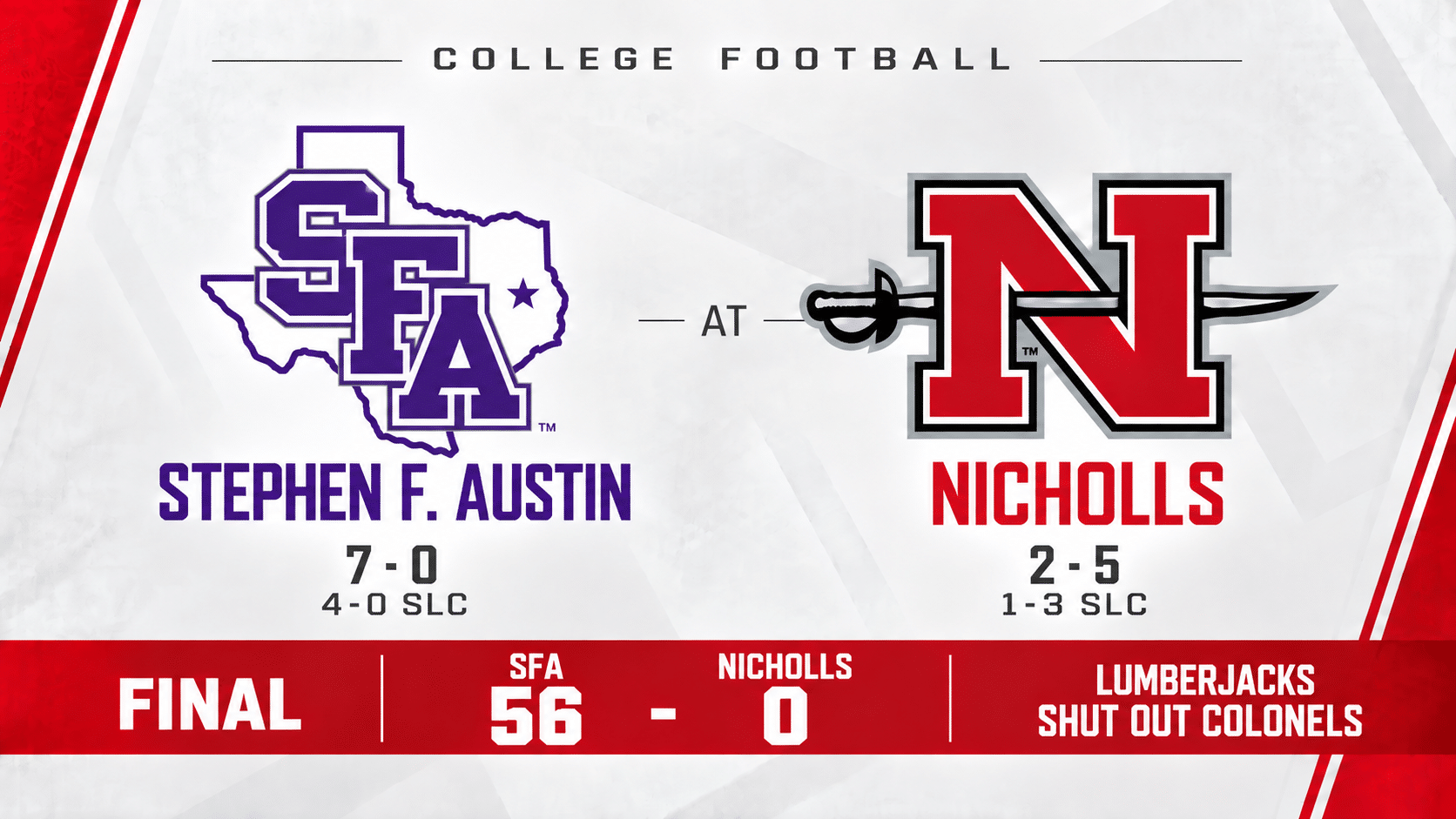
The Lumberjacks dominated from start to finish, defeating Nicholls 56-0 at John L. Guidry Stadium. SFA improved to 7-0 overall and 4-0 in Southland play, while Nicholls fell to 2-5 overall and 1-3 in conference action.
For Stephen F. Austin, Saturday was another example of why the Lumberjacks have been so impressive this season. For Nicholls, it was another disappointing performance in a season that continues to move in the wrong direction.
The Colonels have now scored just 20 points over their last four games, and with the season entering its final stretch, there are some legitimate questions about where this program goes from here.
SFA Shows Why It Belongs Among the Best
Stephen F. Austin has found ways to win games throughout the season, but Saturday’s performance was about as complete as it gets.
The Lumberjacks finished with 642 yards of total offense, including 354 rushing and 288 passing. They averaged 8.9 yards per play, recorded 30 first downs, and scored touchdowns in every quarter.
Quarterback Gavin Rutherford completed 13 of 20 passes for 233 yards and four touchdowns. Bugs Mortimer was his favorite target, catching six passes for 103 yards and three touchdowns.
SFA also had plenty of success on the ground. Jeffery Jones rushed for 100 yards on nine carries, while JT Kitna added 102 yards and a touchdown, including a 94-yard scoring run in the fourth quarter.
Preston Alford also found the end zone twice on the ground.
What makes this SFA team so impressive isn’t just the talent. It’s how well the Lumberjacks execute in all three phases of the game.
They are disciplined in their assignments, take advantage of opportunities, and have shown they can win games in different ways. Saturday was another example of why SFA deserves serious consideration for the top spot in the national rankings.
Nicholls Struggles to Find Answers Offensively
The Colonels actually opened Saturday’s game with a promising drive.
Nicholls marched 68 yards on 10 plays, reaching the SFA seven-yard line before turning the ball over on downs. That would prove to be one of the few offensive opportunities the Colonels could put together.
SFA responded with a 93-yard touchdown drive, and things quickly went downhill for Nicholls.
The Lumberjacks led 14-0 after the first quarter and extended that lead to 35-0 by halftime.
Nicholls finished with just 230 yards of total offense, including 124 rushing and 106 passing. The Colonels averaged only 3.7 yards per play, converted four of 15 third-down attempts, and went 0-for-3 on fourth down.
Three quarterbacks saw action for Nicholls.
Preston Welch completed eight of 16 passes for 82 yards and an interception. Chase Richardson completed four of nine passes for 25 yards, while Ean Rodrigue completed his lone attempt for a loss of one yard.
Richardson also rushed for 30 yards on 15 carries.
Shane Lee added 27 rushing yards, while Ellis Stewart led the receivers with three catches for 40 yards.
The numbers tell much of the story, but the bigger concern is that Nicholls has struggled to establish any consistency offensively for several weeks.
The Colonels have scored only 20 points over their last four games. That’s an average of five points per game.
Regardless of the opponents, that’s simply not enough offensive production to consistently compete in the Southland Conference.
Defense Unable to Slow Down SFA
While much of the focus will understandably be on the offense, Nicholls also had its struggles defensively.
The Colonels allowed SFA to rush for 354 yards and pass for another 288. The Lumberjacks consistently found room to operate, whether running the football or attacking through the air.
SFA scored on drives of 93, 70, and 80 yards, showing it could move the ball even without favorable field position.
Kevin Martin Jr. led Nicholls with nine tackles, while Alec Haynes finished with six.
Nicholls did force two fumbles and recover both, but those opportunities did not result in points.
There were moments where individual players made good plays defensively, but the overall performance wasn’t enough against an offense operating at the level SFA has shown this season.
The Colonels also committed 11 penalties for 102 yards, another area that made an already difficult matchup even more challenging.
What’s Next for Nicholls?
This is where the conversation becomes bigger than Saturday’s loss.
Nobody expected Nicholls to have an easy afternoon against Stephen F. Austin. The Lumberjacks are undefeated for a reason and have established themselves as one of the better teams in the country.
But it’s not necessarily the 56-point loss alone that raises concern. It’s the direction Nicholls has been heading over the last several weeks.
Scoring 20 points over four games is difficult to overlook. The offensive struggles have become a pattern rather than something that happened in one bad game.
That’s why the final portion of this season needs to be about more than simply trying to find another win.
Nicholls needs to begin showing some progress.
First, the Colonels need to establish an offensive identity.
At this point, it’s difficult to determine exactly what Nicholls wants to be offensively.
The Colonels have used multiple quarterbacks, struggled to consistently move the football, and haven’t been able to sustain enough drives to give the defense much help.
With Matt Giampa in his first season as offensive coordinator, there was always going to be an adjustment period. That’s worth recognizing.
However, there also has to be some measurable improvement as the season continues.
Whether that means simplifying the playbook, leaning more heavily on the running game, or finding ways to get the football into the hands of the team’s better playmakers, something needs to begin working.
Second, the coaching staff needs to determine what it has with the current roster.
There is still football left to play, and those games present an opportunity to evaluate players who could be important to the program next season.
That doesn’t mean giving up on the year or simply playing younger players for the sake of playing them.
It means finding the right combinations, identifying who can contribute, and allowing players to develop within a system that fits their abilities.
The quarterback position will certainly be part of that discussion.
With multiple players receiving opportunities this season, Nicholls needs to begin figuring out what gives the offense its best chance to move forward.
Continuing to rotate players without establishing consistency could make an already challenging situation even more difficult.
Third, Nicholls needs to clean up the things it can control.
Penalties, missed assignments, inconsistent execution, and drives that stall before reaching scoring position have all contributed to the Colonels’ struggles.
Those aren’t always talent issues.
Some of those things come down to preparation, discipline, and execution.
Even when facing better teams, Nicholls has to find a way to compete more consistently and avoid making difficult situations worse.
Looking Beyond This Season
There will certainly be questions about the coaching staff if the current struggles continue.
That’s part of college football, especially when a program isn’t meeting expectations.
But making changes simply for the sake of making changes doesn’t always solve the underlying problems.
Head coach Tommy Rybacki and his staff need to be evaluated on the entire season, including how the Colonels respond over the remaining games.
Giampa is in his first season directing the offense, and that should be taken into consideration. At the same time, the lack of offensive production cannot be ignored.
The remaining games should provide an opportunity to determine whether the current staff can make the necessary adjustments and begin moving the program in a better direction.
Nicholls will also have some important decisions to make heading into 2027.
The Colonels need to evaluate the roster, identify areas where additional talent and depth are needed, and determine what type of offensive system gives the program the best opportunity to compete.
In today’s college football landscape, roster management has become just as important as recruiting and developing players.
Keeping the right players in the program, developing younger talent, and filling needs through recruiting and the transfer portal will all be important.
But none of those things will matter much without a clear direction.
The Final Stretch Matters
Nicholls still has opportunities to change the narrative surrounding this season.
The Colonels aren’t going to erase what happened Saturday, and one good performance won’t suddenly fix everything that has gone wrong.
But they can begin building toward something.
The remaining schedule includes Northwestern State, McNeese, East Texas A&M, UIW, and Southeastern Louisiana. Those games will provide opportunities to evaluate where Nicholls stands against the rest of the Southland.
If the current offensive struggles continue, it becomes difficult to see Nicholls finding much success over that stretch.
However, if the Colonels can establish some consistency offensively, reduce mistakes, and begin putting together competitive performances, there’s still something positive that can come out of the remainder of 2026.
This isn’t about criticizing individual players or coaches. There are people working hard every week to represent Nicholls, and one disappointing season shouldn’t erase what this program has accomplished.
But acknowledging the problems is part of figuring out how to correct them.
Nicholls has built a program that has competed for conference championships and established itself as a contender in the Southland.
The expectation should be to get back to that level.
Saturday showed just how much separation currently exists between Nicholls and the team sitting at the top of the conference.
The question now is what the Colonels are going to do about it.
Because at this point, the biggest concern isn’t necessarily where Nicholls finishes the 2026 season. It’s whether the program can show enough improvement to feel confident about where it’s heading in 2027.